

If your solar panels generate more electricity than your home uses during the day, why might you still draw power from the grid after dinner? A solar battery can store some of that daytime surplus and supply it later. How much it helps depends on your household’s energy habits, solar generation and system setup.
Stored energy can help cover evening use, but blackout backup is a separate consideration. A battery can reduce reliance on the grid after sunset, while backup power is available only when the system is designed for it. Some setups can power selected essential circuits rather than the whole home.
This guide explains how a battery charges and supplies power, what affects how much of your household’s use it can cover, and what to consider when adding one to an existing solar system. You’ll also learn how inverter configuration and backup circuits affect blackout protection. Makn Energy is proudly South Australian owned and operated, with licensed local electricians who assess household electrical requirements for solar and battery installations in Adelaide.
Key Takeaways
- Compare daytime solar generation with household demand to see when surplus energy may be available for storage.
- Understand how power moves from your panels to your home, into storage and back to household use later.
- Check the system design and backup circuit configuration before relying on a battery during an outage.
- Use your existing solar setup, daytime use, evening demand and outage priorities to guide a solar battery assessment.
- A local electrician can assess your home’s electrical capacity and how a battery could integrate with your solar system.
What does a solar battery do for an Adelaide home?
Rooftop solar often produces most of its electricity during the day, when household demand may be low. By evening, panels generate less or no power, just as cooking, lighting and entertainment can increase energy use. A home battery helps shift some daytime solar energy to the hours when your household needs it.
A solar battery stores surplus electricity from rooftop panels so your home can use that energy later, when solar generation has fallen. It stores energy rather than generating electricity. How much it can supply depends on the energy available to store, household demand and the system configuration.
Why store solar energy instead of using it straight away?
Solar panels supply the home while they’re generating. If generation exceeds the home’s immediate demand, the surplus can be directed into storage. Later, the stored energy can help run household loads such as lights and appliances after solar generation drops.
For example, a household might use little power while everyone is out during the day, then need more in the evening. Without storage, the home may draw electricity from the grid when the panels aren’t producing enough. A battery can make some stored daytime energy available to meet that later demand.
This shifts when solar energy is used; it doesn’t create more energy. A battery’s contribution varies with generation, household consumption, storage capacity and system settings. Bill outcomes also depend on those factors and the household’s electricity arrangements, so storage shouldn’t be treated as a guaranteed reduction.
Solar battery, grid and home: the basic relationship
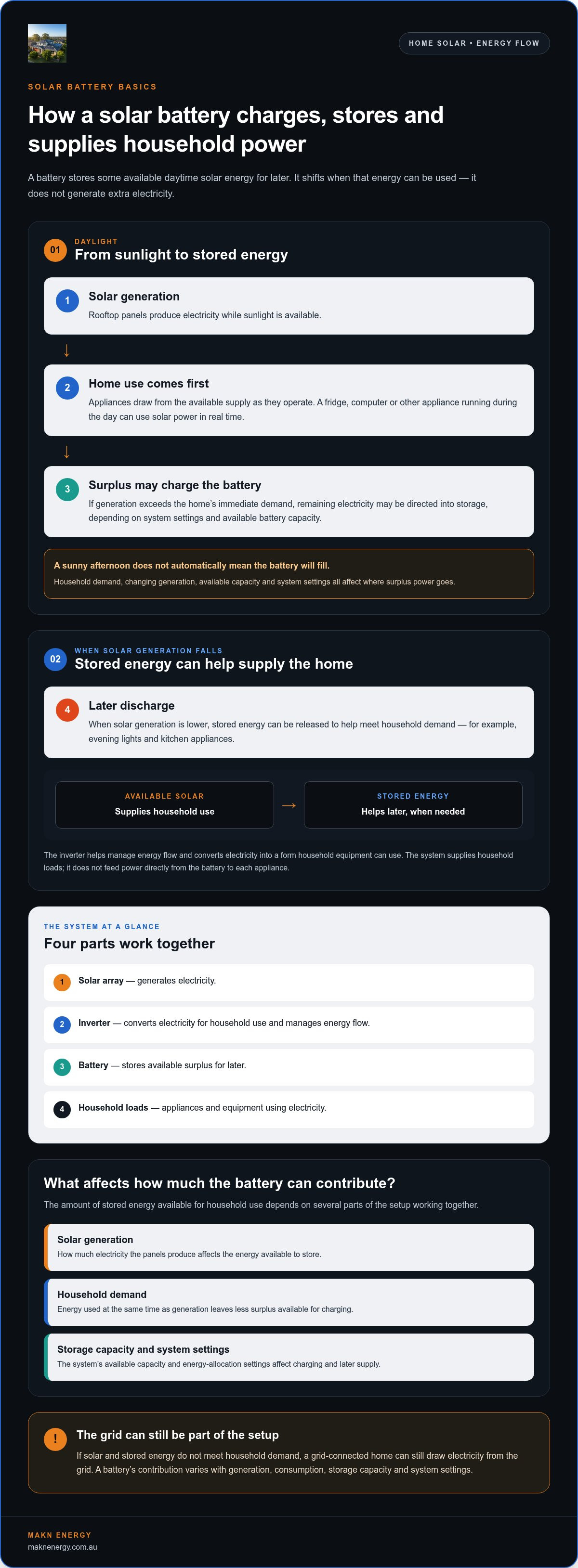
Think of the system as four parts working together. The solar array generates electricity. An inverter converts it into a form household appliances can use and manages energy flow. The battery stores available surplus for later. The household loads are the appliances and equipment using electricity.
During the day, solar power can supply the home first. If generation exceeds household demand, the system may send surplus to the battery, depending on its settings and available capacity. In the evening, the battery can discharge stored energy to help supply the home. If solar and stored energy don’t meet demand, a grid-connected home can still draw electricity from the grid. Adding a battery doesn’t remove the grid from the setup.
That basic storage principle also applies at a larger scale. The Battery storage power station overview describes how stored electricity can be used later, though a home system is designed around household needs.
For an Adelaide home, the practical question is how your generation and demand line up across the day, and how the system can direct energy to suit that pattern.
How a solar battery charges, stores and supplies household power
A home energy system directs electricity as it’s generated and used. The panels produce power, household appliances draw on the available supply, and surplus electricity may charge the battery. Later, stored energy can flow back through the system to supply household loads. How power is allocated depends on solar generation, household demand and system settings.
Solar panels generate electricity; a battery stores some of that electricity for use later. Storage changes when available solar energy can be used, but it doesn’t generate extra power.
The energy flow usually follows four steps:
- Solar generation: Rooftop panels produce electricity while sunlight is available.
- Home use: Appliances draw from the available supply as they operate.
- Battery charging: Surplus electricity can charge the battery if the system is configured to store it.
- Later discharge: Stored energy is released to help supply household demand when solar generation is lower.
What happens to surplus solar power during the day?
Household loads use available solar generation as it’s produced. A fridge, computer or other appliance running during the day can draw power in real time. If the panels produce more than the home needs at that moment, the remaining electricity may charge the battery. The amount available varies with sunlight and household activity.
System settings also affect where surplus power goes. The setup may direct available energy towards charging, household use or export to the grid. A sunny afternoon doesn’t automatically mean the battery will fill. Household demand could be high, generation may vary, or the battery may have limited capacity available to charge.
When does the battery supply energy to the home?
When solar generation falls but household demand continues, the system can draw on stored energy. After sunset, for example, lights and kitchen appliances may use energy from the battery. The system supplies household loads rather than feeding power directly from the battery to each appliance.
The inverter helps manage this flow and converts electricity into a form household equipment can use. Its role is to connect generation, storage and household demand within the system. The arrangement depends on the equipment and design, so an assessment of your home’s solar setup can clarify how energy will flow.
A battery may contribute to evening use, but don’t assume it will cover every appliance all night. The result depends on how much energy was stored, what the home uses and the system settings. Makn Energy’s licensed local electricians assess household electrical requirements for energy installations in Adelaide. Explore home battery storage in Adelaide as part of your household’s energy setup.
What a solar battery can and cannot do during a blackout
A battery in the home doesn’t automatically keep every appliance running during a power outage. Everyday storage and blackout backup are separate outcomes. A system may store energy for use after sunset without being configured to supply power when the grid fails.
In a grid-connected setup, what happens during an outage depends on the system design. Backup requires compatible equipment and a configuration that can safely separate the home from the grid. Without that arrangement, the battery may not provide power during an outage, even if it has charge available.
Does every solar battery keep the house running in a blackout?
No. Backup capability depends on the installed equipment and system configuration. A system designed to isolate the home from the grid during an outage can supply designated circuits, while another grid-connected setup may shut down or respond differently to protect the network. The battery’s presence alone doesn’t show what will stay on. The installed design determines whether backup is available and which parts of the home it can support.
That distinction matters when setting priorities. Using stored energy to reduce grid use in the evening doesn’t necessarily mean the system can provide backup during an outage. Treat these as separate system goals and make sure the design reflects what you want for your Adelaide home.
Which household circuits might need backup?
Start by listing the services you’d most want to keep operating during an outage. For some households, that could include refrigeration, selected lighting and communications equipment. Then consider which appliances are essential at the same time. Backup priorities help shape system design, but they don’t guarantee every appliance can run together or for a particular length of time.
A licensed electrician can assess your home’s electrical capacity and circuit requirements, then plan how essential loads could be separated from other circuits. Makn Energy’s licensed local electricians assess household electrical requirements as part of energy installations in Adelaide. Focus on what you need powered, rather than assuming the whole home will be covered.
Installation and connection requirements can change, so check current South Australian guidance when planning a system. Treat blackout support as a specific design goal, not an automatic feature of storage. Explore home battery storage in Adelaide to plan around your home’s setup and priorities.
How to assess whether a solar battery fits your household
Start with your household’s energy pattern, not a battery size. A useful assessment looks at when your solar system generates electricity, when the home uses it and what you want a battery to achieve. Everyday energy use and blackout backup are different priorities, so consider them separately before deciding on a system design.
What should you review before considering storage?
Gather recent electricity bills and, if available, solar monitoring records. Look at when your home draws power and note when major appliances usually run. A household that uses most of its electricity during the day has a different storage profile from one with heavier evening demand.
- Daytime use: Note whether appliances, work-from-home equipment or other regular loads operate while the panels are generating.
- Evening demand: Identify the appliances typically used after solar generation falls, such as cooking equipment, lighting and entertainment devices.
- Existing solar equipment: Record your panel system and inverter details where available. These help inform how storage could integrate with the existing setup.
- Backup priorities: Make a separate list of essential circuits you’d want powered during an outage, rather than assuming everyday storage provides blackout support.
Battery sizing is a separate assessment. It should reflect household consumption alongside the solar and electrical setup, not simply a general household category or a single figure from a bill. A licensed electrician can assess electrical capacity and system details, including how an existing inverter may affect the design. This site-specific view helps match the proposed system to your energy use and priorities.
How Adelaide conditions and local connections fit the decision
Adelaide homes don’t all have the same roof, solar equipment or daily routine. Your generation pattern and available installation space are part of the property assessment, while household schedules shape when stored energy may be useful. A recommendation should account for both rather than assume one battery size suits every home in the area.
South Australian connection requirements can also affect system planning. Requirements may depend on the connection and proposed installation, so current guidance should be considered as part of the project. SA Power Networks provides information relevant to local electricity connections; applicable requirements should be considered alongside the property’s electrical capacity and existing solar equipment.
Use your energy records and equipment details as a starting point, then have the home’s setup assessed before deciding on capacity. Makn Energy’s licensed local electricians assess household electrical requirements for energy installations in Adelaide, connecting the technical design to your everyday use and backup priorities. Explore home battery storage with Makn Energy for an installation suited to your property.
Planning a solar battery installation with a local Adelaide electrician
A sound installation starts with your household’s priorities, not a product specification. Do you want to use more of your solar energy after dark, support selected circuits during an outage, or plan for both? Those aims shape the assessment and system design. A local electrician can consider your existing solar equipment and the property’s electrical setup before recommending an approach.
A practical planning sequence is:
- Discuss your priorities: Describe your typical energy use and what you’d want a battery to do.
- Assess the property: Review the solar system, electrical capacity, available installation space and household requirements.
- Design the system: Match the battery and system configuration to your home’s use and any backup priorities.
- Install and explain: Complete the installation, then go through how the system operates and what to expect in everyday use.
What happens during a household battery assessment?
The assessment brings together information about your solar panels and inverter, your household energy needs and your property’s electrical setup. Existing solar equipment matters because the battery must be planned as part of the broader system. Your electrician can assess electrical capacity and how the proposed equipment may integrate with what’s already installed.
Bring recent energy records if you have them, along with details of appliances you use regularly and when they operate. Be clear about the difference between everyday use and outage support. For example, reducing grid use in the evening and keeping refrigeration or selected lights operating in an outage are distinct design priorities. The system should reflect your needs, rather than assume one setup suits every home.
Connection requirements are also part of planning. Requirements can depend on the property and the proposed system, so use current South Australian guidance when planning an installation. SA Power Networks information can help identify applicable connection requirements for your project. Avoid relying on old advice when planning a new or upgraded system.
What to expect from Makn Energy’s Adelaide installation support
Makn Energy is proudly South Australian owned and operated, supplying and installing residential solar panels and home battery storage across Adelaide. Its licensed local electricians assess household electrical requirements for energy installations. Planning takes account of the existing solar system and the home’s electrical capacity, as well as your energy and backup priorities.
A useful conversation begins with how your household uses power and what you’d like storage to achieve. The property assessment then informs a design tailored to the home. Installation and an explanation of system operation help you understand how the battery fits into your energy setup. A solar battery is a considered addition, not a one-size-fits-all decision.
Ready to discuss a home battery system for your Adelaide property? Talk with Makn Energy about home battery storage.
Make your next energy decision with confidence
You don’t need to settle every technical detail before taking the next step. Start by deciding what you want storage to do for your home. A clear priority gives the system assessment direction and keeps the discussion focused on your household rather than a one-size-fits-all solution.
A solar battery is a considered addition to your home’s energy setup, and the right fit depends on your property and goals. If you’re weighing up the options, a conversation can help turn your priorities into a practical plan.
Makn Energy is proudly South Australian owned and operated, providing residential solar and home battery installation across Adelaide. Its licensed local electricians assess household electrical requirements as part of energy installations. Talk with Makn Energy about home battery storage and plan your next step.
Frequently Asked Questions
How does a solar battery work with rooftop panels?
A solar battery works alongside the panels and inverter, storing available solar electricity for later use. For example, if your panels are producing while you’re out and the home is using little power, some surplus may be stored rather than used immediately. System settings and household demand affect the flow. In Adelaide, an assessment can show how storage could fit with your existing solar equipment.
Can a solar battery power my home during a blackout?
It can, but only if the installed system is designed and configured for backup. Some systems may support selected circuits rather than the entire home. Think about what matters most during an outage, such as keeping the fridge operating or maintaining lighting in key rooms. The stored energy and connected loads also affect what can run, so don’t assume every appliance will stay on.
What happens to solar power when the battery is full?
Once the battery reaches its configured charge limit, the system has to direct available solar power elsewhere. Depending on the system and connection arrangements, surplus may be exported to the grid or the panels’ output may be adjusted. What happens in your home depends on its settings and applicable connection conditions. Makn Energy can explain how the system is set up to manage surplus generation.
Can I add a solar battery to my existing solar system?
Often, storage can be added to an existing solar setup, but compatibility depends on the equipment already installed and the property’s electrical capacity. The inverter, system layout and connection arrangements all affect the design. Gather your panel and inverter details if you have them. Makn Energy can assess how a battery could integrate with your Adelaide home’s current system.
How much solar battery capacity does a house need?
There isn’t one capacity that suits every home. Base the assessment on how much electricity the household uses, when it uses it and how much solar power is available to store. Regular evening use and daytime appliance use, for example, create different storage needs. A suitable capacity assessment considers your energy records alongside the solar and electrical setup, rather than relying on household size alone.
Is a solar battery worth it if I already have solar panels?
It depends on how closely your solar generation matches your household’s energy use. If you use much of your solar power while it’s being generated, the amount available to store may be limited. If more of your demand comes later, storage may better align solar energy with your routine. Compare your usage patterns and system details before deciding; a battery isn’t automatically the right next step for every solar home.
Do solar batteries work when the grid is down?
Not automatically. During an outage, a grid-connected system needs suitable equipment and a configuration that can safely operate separately from the grid. Backup may be limited to selected circuits. Some systems may also be designed to use available solar generation to recharge storage during an outage, but this depends on the installed setup. Makn Energy can explain the system’s intended operation and limits as part of the design.